
Machine learning has become a fundamental part of our daily lives, working behind the scenes in countless applications we use every day. Understanding how machine learning algorithms function in real-world scenarios helps you grasp why technology works the way it does and why it’s transforming industries worldwide.
How Algorithms Learn From Data
At its core, machine learning operates by processing large amounts of data to identify patterns and make predictions. Unlike traditional programming where you write specific instructions for every task, machine learning algorithms learn from examples. When you feed an algorithm training data, it analyzes the information and develops rules on its own.
Think of it like teaching a child to recognize animals. You don’t write down every possible feature of a dog. Instead, you show them many examples until they understand what makes a dog different from a cat. Machine learning algorithms work similarly. They examine thousands or millions of examples to understand patterns and make intelligent decisions.
The process starts with data collection. Companies gather information about their customers, products, or systems. This raw data becomes the foundation for training algorithms. The more quality data you provide, the better the algorithm learns.
Training and Testing the Algorithm
Machine learning professionals split their data into two parts: training data and testing data. They use the training portion to teach the algorithm, allowing it to identify patterns and create a model. The testing portion helps verify that the algorithm actually works correctly on new information it hasn’t seen before.
During training, the algorithm makes predictions and checks how often it gets them right. When it makes mistakes, it adjusts itself to improve accuracy. This cycle repeats until the algorithm reaches acceptable performance levels. This continuous improvement process is what makes machine learning so powerful in real-world applications.
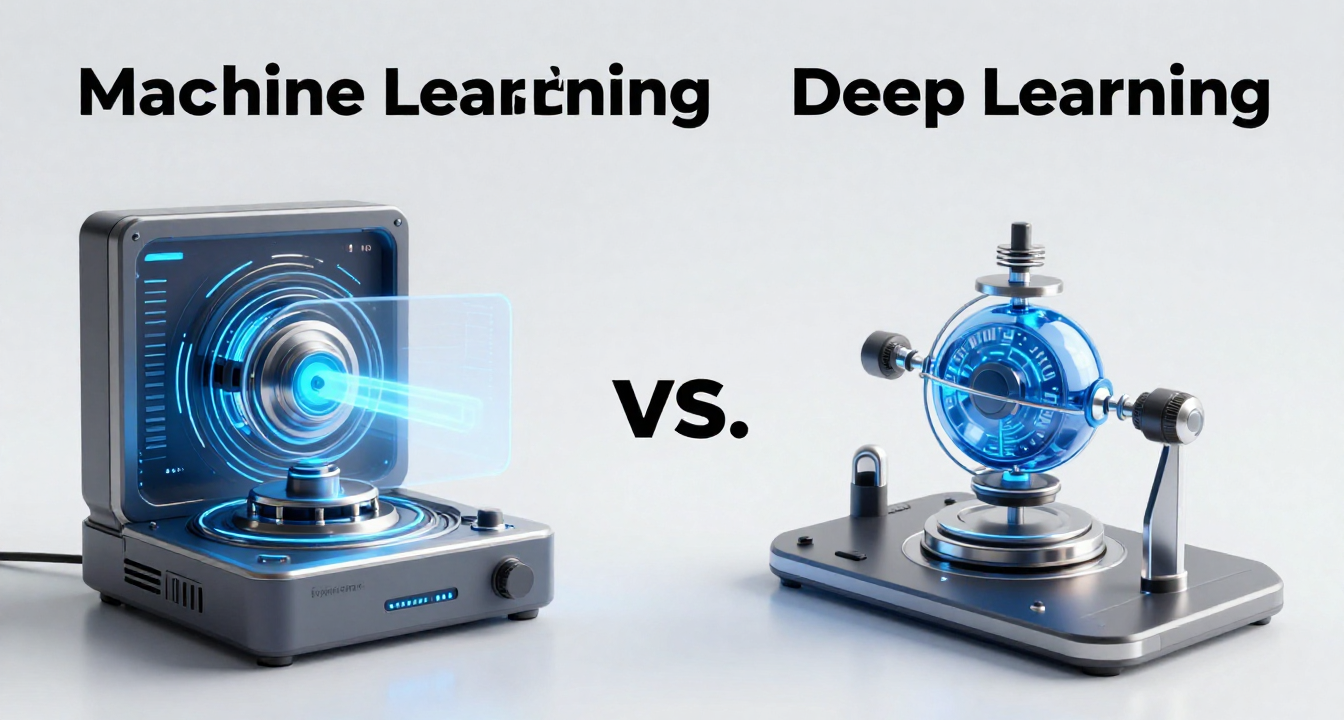
Machine Learning vs. Deep Learning in Practice
While discussing how algorithms work in real applications, it’s important to understand that machine learning encompasses various techniques. Traditional machine learning algorithms like decision trees, random forests, and support vector machines have proven effective for many tasks. These algorithms are often simpler to understand and require less computational power.
Deep learning, a specialized branch of machine learning, uses neural networks with multiple layers to process information. Deep learning excels at handling complex tasks like image recognition and natural language processing. However, deep learning typically requires more data and computing resources. For many practical applications, simpler machine learning approaches work just as well and are more cost-effective.
Real-World Applications Across Industries
Email filtering demonstrates a straightforward application of machine learning. When you mark emails as spam, the system learns from your actions. The algorithm analyzes characteristics of spam messages and gradually improves at identifying similar emails automatically. This happens without any programmer writing specific rules for every spam pattern.
In healthcare, machine learning algorithms help doctors detect diseases early. These systems analyze medical images like X-rays and MRIs, comparing them to thousands of previous cases. The algorithm identifies patterns that might indicate cancer, heart disease, or other conditions. Doctors then use these insights alongside their expertise to make better treatment decisions.
Streaming services like Netflix use machine learning to recommend movies and shows you’ll probably enjoy. The algorithm examines your viewing history, ratings, and preferences. It also looks at what similar users watch. By analyzing these patterns, the system suggests content tailored specifically to your interests.
Banks deploy machine learning for fraud detection. When you make unusual purchases or withdrawals, the system flags them for review. The algorithm learns what normal behavior looks like for each customer and alerts security teams when something seems wrong. This protects your account from unauthorized access.
The Importance of Quality Data
The success of any machine learning application depends heavily on data quality. Algorithms learn from the information you give them, so biased or incomplete data leads to poor results. Companies must carefully prepare their datasets, removing errors and ensuring representation across all relevant groups.
Data preprocessing is often the most time-consuming part of implementing machine learning. Professionals clean the data, handle missing values, and standardize information formats. They also work to eliminate bias that might cause the algorithm to make unfair decisions about certain groups of people.
Measuring Success and Performance
How do you know if a machine learning algorithm is working well? Companies use specific metrics to evaluate performance. Accuracy measures how often the algorithm makes correct predictions. Precision shows how many of its positive predictions were actually correct. Recall indicates how many actual cases the algorithm successfully identified.
Different applications require different balance between these metrics. A medical diagnosis system might prioritize recall, wanting to catch every possible case of disease, even if it means some false alarms. A spam filter might prioritize precision, wanting to avoid blocking legitimate emails even if some spam gets through.
| Metric | Definition | Common Use |
|---|---|---|
| Accuracy | Percentage of correct predictions | General performance measurement |
| Precision | Correct positive predictions divided by all positive predictions | Spam detection, fraud prevention |
| Recall | Correct positive predictions divided by all actual positives | Disease detection, security threats |
| F1 Score | Balance between precision and recall | When both metrics matter equally |
Challenges in Deploying Algorithms
Moving a machine learning model from development to production brings new challenges. The algorithm might perform perfectly in testing but struggle with real-world data that’s messier and more varied. Developers must continuously monitor performance and update the algorithm as patterns change.
Explainability is another growing concern. Modern machine learning tools sometimes make decisions in ways humans can’t easily understand. In critical applications like healthcare or criminal justice, understanding why an algorithm made a specific decision becomes essential for trust and accountability.
The Future of Algorithms in Business
Machine learning continues evolving as companies develop better techniques and have access to more data.
Understanding Neural Networks and Deep Learning Technology
When you dive into the world of artificial intelligence, you’ll quickly encounter two terms that often get confused: machine learning and deep learning. While they’re closely related, understanding the differences between them helps you grasp how modern technology actually works. Let’s explore what makes each approach unique and how they shape the technology you use every day.
What Is Machine Learning and How Does It Work?
Machine learning is a branch of artificial intelligence that enables computers to learn from data without being explicitly programmed for every scenario. Instead of following strict rules that a programmer writes, machine learning algorithms identify patterns in data and make decisions based on those patterns.
Think of it like teaching a child to recognize different animals. Instead of describing every possible dog in existence, you show the child several examples of dogs and let them figure out what makes a dog a dog. The child learns the common features and can recognize new dogs they’ve never seen before. Machine learning works similarly—it learns from examples rather than following predetermined instructions.
Machine learning algorithms need humans to identify which features matter most. For example, if you’re building a system to detect spam emails, a human must decide which characteristics are important, like the sender’s address, email length, or certain keywords. The algorithm then uses these human-selected features to make predictions.
Common machine learning applications include recommendation systems that suggest movies, email filters that catch spam, and medical diagnosis tools that help doctors identify diseases. These systems have transformed how businesses operate and improved countless services you interact with daily.
Understanding Deep Learning Technology
Deep learning is a specialized subset of machine learning that uses artificial neural networks with multiple layers. The “deep” part refers to having many layers within the neural network structure. This approach mimics how the human brain processes information, making it particularly powerful for complex tasks.
Instead of humans telling the system which features to focus on, deep learning algorithms automatically discover the representations needed for detection or classification. The network learns what features matter by analyzing enormous amounts of data and adjusting itself through a process called backpropagation.
Imagine you want a computer to recognize faces in photos. With traditional machine learning, you’d need to manually identify facial features that matter—like eye distance, nose shape, and chin structure. With deep learning, you simply feed thousands of face photos into the system, and it automatically learns which features are important without you telling it. This self-learning capability is what makes deep learning so powerful.
Deep learning excels at tasks involving unstructured data like images, audio, and text. Voice assistants, image recognition systems, and language translation tools all rely heavily on deep learning technology. These systems can process information in ways that more closely resemble human thinking.
Key Differences Between Machine Learning and Deep Learning
The main distinctions between these two approaches affect how they’re used and what they can accomplish:
| Aspect | Machine Learning | Deep Learning |
|---|---|---|
| Feature Engineering | Humans manually select relevant features | System automatically learns features |
| Data Requirements | Works well with smaller datasets | Requires large amounts of data |
| Computational Power | Can run on standard computers | Typically needs GPUs or specialized hardware |
| Processing Time | Faster training and predictions | Longer training but powerful results |
| Interpretability | Easier to understand decision-making | More like a “black box” system |
Feature engineering represents perhaps the biggest practical difference. In machine learning, you spend considerable time deciding which characteristics of your data matter most. This human insight can make or break the system’s success. Deep learning removes this burden by having the system figure out important features automatically, but it needs significantly more data to do so effectively.
The computational requirements also differ substantially. A machine learning system might run smoothly on your laptop, while deep learning typically requires powerful graphics processing units (GPUs) that are more expensive. However, this extra computational investment often pays off when dealing with complex problems.
When to Use Machine Learning Versus Deep Learning
Choosing between these approaches depends on your specific situation. If you have a smaller dataset and want quick results with clear interpretability, machine learning might be your best choice. These algorithms work well for business problems like customer churn prediction, fraud detection, and sales forecasting.
Deep learning shines when you have massive amounts of data and access to computational resources. Use deep learning for tasks like computer vision, natural language processing, and speech recognition where the patterns are too complex for humans to manually define.
Many modern solutions actually combine both approaches. You might use deep learning to automatically extract features from raw data, then pass those features to a machine learning algorithm for final predictions. This hybrid strategy lets you leverage the strengths of each technology.
The Relationship Between These Technologies
It’s important to understand that deep learning isn’t meant to replace machine learning—it’s an evolution of it. Deep learning is specifically a subset of machine learning techniques that uses neural networks with multiple layers. Every deep learning system is technically a machine learning system, but not every machine learning system uses deep learning.
Think of it like vehicles and cars. All cars are vehicles, but not all vehicles are cars. Similarly, all deep learning falls under machine learning, but machine learning encompasses many other techniques beyond deep learning.
The field continues evolving as researchers develop new approaches and improve existing ones. Understanding both concepts helps you make informed decisions about which technology suits your needs best. Whether you’re working on a business problem or exploring artificial intelligence, knowing the strengths and limitations of each approach is essential for success.
For more detailed information about these technologies, you can explore resources like TensorFlow’s machine learning resources an
Choosing the Right Approach: When to Use Machine Learning or Deep Learning
<p>Artificial intelligence has transformed how businesses solve problems and make decisions. Two powerful approaches within this field often create confusion: machine learning and deep learning. Understanding which one to use for your specific needs can make the difference between success and wasted resources.</p>

<p>When you're deciding between these two technologies, you need to understand what sets them apart. Machine learning and deep learning both use data to learn patterns, but they work in different ways. Knowing these differences helps you pick the right tool for your project.</p>

<h3>Understanding Machine Learning Fundamentals</h3>

<p>Machine learning allows computers to learn from data without being explicitly programmed for every situation. Instead of following rigid instructions, these systems recognize patterns and improve over time. You can think of it as teaching a computer to make smart decisions based on examples it observes.</p>

<p>This approach works well when you have structured data that humans can understand. For example, if you're predicting house prices, machine learning can analyze features like square footage, location, and age. A data scientist typically selects which features matter most, then the algorithm learns relationships between these features and the outcome.</p>

<p>Common machine learning algorithms include decision trees, random forests, and support vector machines. Each one excels at different types of problems. You'll find machine learning powering recommendation systems, spam filters, and fraud detection tools in your daily life.</p>

<p>One major advantage of machine learning is that it requires less computational power than deep learning. You can run many machine learning models on standard computers or laptops. Training times are also typically much shorter, sometimes taking only hours or minutes.</p>

<h3>Exploring Deep Learning Capabilities</h3>

<p>Deep learning is a specialized subset of machine learning that uses artificial neural networks with multiple layers. These networks mimic how your brain processes information. Each layer in the network transforms data into increasingly abstract representations, allowing the system to understand complex patterns.</p>

<p>Deep learning shines when dealing with unstructured data like images, videos, and natural language. If you're building a system that recognizes faces in photos or understands human speech, deep learning becomes your powerful ally. The network automatically discovers which features are important without humans having to specify them.</p>

<p>Popular deep learning architectures include convolutional neural networks for image recognition and recurrent neural networks for sequential data. You've likely interacted with deep learning through voice assistants, image filters on your phone, and translation services.</p>

<p>The trade-off is that deep learning demands significant computing resources and massive amounts of data. Training a deep learning model can take weeks or months using specialized hardware like GPUs. You'll also need larger datasets to achieve good results compared to traditional machine learning.</p>

<h3>Comparing Key Differences</h3>

<table border="1" cellpadding="10" cellspacing="0">
<tr>
<th>Aspect</th>
<th>Machine Learning</th>
<th>Deep Learning</th>
</tr>
<tr>
<td><strong>Data Requirements</strong></td>
<td>Works with smaller datasets</td>
<td>Requires large amounts of data</td>
</tr>
<tr>
<td><strong>Computational Power</strong></td>
<td>Standard computers sufficient</td>
<td>GPUs and specialized hardware needed</td>
</tr>
<tr>
<td><strong>Training Time</strong></td>
<td>Minutes to hours</td>
<td>Hours to weeks</td>
</tr>
<tr>
<td><strong>Feature Engineering</strong></td>
<td>Manual feature selection required</td>
<td>Automatic feature learning</td>
</tr>
<tr>
<td><strong>Interpretability</strong></td>
<td>Results are often explainable</td>
<td>Often acts as a "black box"</td>
</tr>
<tr>
<td><strong>Best For</strong></td>
<td>Structured data, classification, regression</td>
<td>Images, audio, text, complex patterns</td>
</tr>
</table>

<h3>Evaluating Your Project Requirements</h3>

<p>Start by examining the type of data you're working with. If your data is structured and organized in tables or spreadsheets, machine learning often provides the best solution. You can easily interpret why the model made specific predictions, which matters in industries like finance and healthcare where transparency is crucial.</p>

<p>When you're dealing with unstructured data like photographs, voice recordings, or written text, deep learning typically performs better. It can extract meaningful patterns from raw information that would be nearly impossible to describe manually.</p>

<p>Consider your available resources too. Do you have access to powerful computers with GPUs, or are you working with standard equipment? Machine learning runs efficiently on modest hardware, making it accessible for startups and smaller projects. Deep learning requires investment in infrastructure and specialized expertise.</p>

<p>Your dataset size matters significantly. If you only have hundreds or thousands of examples, machine learning usually works better. Deep learning needs millions of examples to train effectively and avoid overfitting. If your dataset is limited, machine learning reaches good performance with much less data.</p>

<h3>Making the Right Choice for Your Business</h3>

<p>Budget constraints often determine which approach you can pursue. Machine learning projects typically cost less because they require fewer computational resources and shorter development times. Deep learning projects demand larger budgets for hardware, specialized talent, and extended timelines.</p>

<p>Think about your timeline too. If you need results quickly, machine learning gets you answers faster. Deep learning might take considerably longer before producing useful outputs. For time-sensitive business problems, the speed of machine learning development becomes an advantage.</p>

<p>Interpretability and compliance regulations matter in certain industries. Machine learning models are generally easier to explain to non-technical stakeholders and regulatory bodies. Deep learning's complexity makes it harder to demonstrate why the system reached a particular conclusion, which can be problematic in regulated industries.</p>

<p>You should also consider the expertise available on your team. Machine learning requires standard data science skills that many professionals possess. Deep learning demands specialists with deep neural network expertise, which can be harder to find and more expensive to hire.</p>

<h3>Real-World Application Scenarios</h3>

<p>A retail company analyzing customer purchase history to predict future buying behavior would benefit from machine learning. The structured sales data, reasonable dataset size, and need for clear explanations make it ideal. You can quickly train a model and understand which factors influence customer decisions.</p>

<p>A social media company building a system to identify offensive images in user posts would choose deep learning. The unstructured nature of image data and the massive volume of
Future Trends and the Evolution of Machine Learning and Deep Learning Technologies
The world of artificial intelligence is changing faster than ever before. Machine learning and deep learning are two technologies that sit at the heart of this revolution. While many people use these terms interchangeably, they represent distinct approaches to teaching computers to learn and make decisions. Understanding the difference between machine learning vs. deep learning is essential if you want to grasp where technology is heading in the coming years.
Both machine learning and deep learning share a common goal: they help computers learn from data without being explicitly programmed for every scenario. However, the way they achieve this goal differs significantly. Machine learning uses algorithms that identify patterns in data, while deep learning mimics how the human brain processes information through artificial neural networks. As technology evolves, these two approaches are becoming increasingly intertwined, creating powerful solutions for real-world problems.
Understanding the Core Differences
When you compare machine learning vs. deep learning, you’re really looking at two different levels of complexity. Machine learning is the broader field that encompasses various algorithms designed to improve automatically through experience. This includes decision trees, support vector machines, and random forests. These algorithms work well when you have structured data and clear problems to solve.
Deep learning, on the other hand, is a specialized subset of machine learning. It uses artificial neural networks with multiple layers to process information. These layers allow the system to learn representations of data at different levels of abstraction. Think of it like how you recognize your friend’s face—your brain uses multiple layers of processing, from basic features like edges and colors to complex patterns like facial features. Deep learning attempts to replicate this process.
The fundamental distinction in machine learning vs. deep learning comes down to feature engineering. With traditional machine learning, humans must manually identify and select which features matter most. A data scientist might decide that certain measurements or characteristics are important for making predictions. With deep learning, the system automatically discovers these features through its layered architecture. This automatic feature discovery is one reason deep learning has become so powerful for complex tasks.
Why Machine Learning Still Matters
You might think that deep learning has completely replaced machine learning, but that’s not the case. Machine learning remains incredibly valuable for many applications. When you’re working with smaller datasets or simpler problems, machine learning often provides better results with less computational power. It’s also more interpretable, meaning you can actually understand why the algorithm made a specific decision.
Consider a business trying to predict customer churn. Machine learning algorithms can identify patterns in customer behavior and flag which customers are likely to leave. The algorithms work quickly, require less data, and the results are easier to explain to stakeholders. This practical advantage keeps machine learning relevant in countless industries, from healthcare to finance to retail.
Another advantage of machine learning is its efficiency. These algorithms require far less computational resources than deep learning models. You don’t need expensive graphics processing units or massive cloud infrastructure to run effective machine learning solutions. This makes machine learning accessible to smaller companies and organizations with limited budgets.
The Rise of Deep Learning Applications
Deep learning has revolutionized several fields where traditional machine learning vs. deep learning comparisons clearly favor the newer approach. Computer vision, natural language processing, and speech recognition have all been transformed by deep learning technology. When you use facial recognition on your smartphone, you’re benefiting from deep learning. When you ask a voice assistant a question, deep learning helps it understand what you said and formulate a response.
The success of deep learning comes from its ability to handle unstructured data like images, text, and audio. These types of data don’t fit neatly into rows and columns like traditional datasets. Deep learning’s layered approach naturally handles the complexity of unstructured information. This capability has opened doors to applications that were previously impossible.
Recent breakthroughs in large language models demonstrate the power of deep learning. Systems like transformers can process massive amounts of text and learn sophisticated language patterns. The machine learning vs. deep learning debate in natural language processing is essentially settled—deep learning has proven far superior for this task.
Emerging Trends Shaping the Future
Looking ahead, several trends are influencing how machine learning and deep learning will evolve. One significant trend is the push toward more efficient models. Researchers are developing deep learning systems that require less data and less computational power. This democratization means smaller organizations can benefit from advanced AI technology.
Another important trend is the integration of both approaches. Rather than viewing machine learning vs. deep learning as competing technologies, forward-thinking companies are combining them. They might use deep learning to extract features from raw data, then apply machine learning algorithms for classification or prediction. This hybrid approach often delivers superior results.
Edge computing is also reshaping the landscape. As deep learning models become smaller and faster, they can run directly on devices rather than requiring cloud servers. Your smartphone or smart device will increasingly perform sophisticated AI tasks without sending data elsewhere. This shift addresses privacy concerns and reduces latency, making real-time applications more practical.
Explainability has become increasingly important. Users and regulators want to understand how AI systems make decisions. While deep learning models have traditionally been “black boxes,” new techniques are making them more transparent. This focus on interpretability might lead to greater reliance on hybrid approaches where machine learning’s transparency complements deep learning’s power.
Real-World Impact and Future Possibilities
The distinction between machine learning vs. deep learning matters in practical applications. In healthcare, machine learning helps doctors predict patient outcomes, while deep learning analyzes medical images. In autonomous vehicles, both technologies work together—deep learning recognizes objects and obstacles, while machine learning algorithms make driving decisions.
Manufacturing is experiencing transformation through both approaches. Machine learning predicts equipment failures, preventing costly downtime. Deep learning inspects products for defects with superhuman accuracy. Together, they’re making factories smarter and more efficient.
Financial institutions increasingly rely on these technologies. Machine learning algorithms detect fraudulent transactions instantly. Deep learning analyzes market trends and patterns that humans might miss. The combination creates robust systems that protect customers while identifying opportunities.
Preparing for Tomorrow’s Technology
As these technologies continue evolving, the gap between machine learning vs. deep learning will likely blur further. New hybrid architectures are already emerging that combine the best aspects of both. Quantum computing may eventually change how both technologies function, offering unprecedented processing power.
For organizations and professionals, understanding both machine learning and deep learning is essential. Rather than choosing one over the other, the future belongs to those who can strategically apply both technologies. Knowledge of when to use traditional machine learning and when to deploy deep learning gives you a competitive advantage.
The exciting reality is that machine learning an
Key Takeaway:
Key Takeaways: Machine Learning vs. Deep Learning
Understanding the differences between machine learning and deep learning is essential for anyone working with artificial intelligence today. While these terms often get used interchangeably, they represent distinct approaches to solving problems with data.
The Fundamental Distinction
Machine learning vs. deep learning comes down to complexity and how systems learn. Machine learning is the broader field where computers improve their performance by learning from data without explicit programming. Deep learning is a specialized subset that uses artificial neural networks inspired by how our brains work. Think of machine learning as the umbrella, and deep learning as one of many tools underneath it.
Machine learning algorithms work by identifying patterns in data through mathematical formulas. They’re straightforward to understand and implement. Deep learning, on the other hand, processes information through multiple layers of artificial neurons, making it more powerful but also more complicated to understand and manage.
Real-World Applications Matter
The choice between machine learning and deep learning depends on your specific needs. Machine learning works wonderfully for many everyday tasks like predicting customer behavior, detecting spam emails, or analyzing sales trends. You don’t need massive amounts of data or expensive computer systems to get results.
Deep learning shines when you’re dealing with complex tasks like recognizing faces, understanding spoken language, or analyzing medical images. These applications benefit from deep learning’s ability to discover intricate patterns that simpler algorithms might miss.
Planning Your AI Strategy
When deciding between machine learning vs. deep learning, consider your resources and goals. Machine learning requires less data, less computing power, and faster results. Deep learning needs substantial data, powerful computers, and more time, but delivers superior performance on highly complex problems.
Looking Ahead
The future will likely see both technologies evolving together. Machine learning will become faster and more efficient, while deep learning continues advancing artificial intelligence capabilities. Understanding when to use each approach positions you to leverage the best technology for your business challenges. The real power comes from knowing which tool solves your specific problem most effectively and efficiently.
Conclusion
Machine learning and deep learning represent two powerful approaches to artificial intelligence, each with distinct strengths and applications. Throughout this exploration, you’ve discovered that machine learning offers flexibility and efficiency for many business problems, while deep learning excels when you’re working with massive amounts of unstructured data like images, audio, and text.
The key takeaway is understanding that deep learning is actually a specialized branch of machine learning. You don’t always need the complexity of deep learning to solve your challenges. Sometimes, traditional machine learning algorithms deliver faster results with less computational power. The real skill lies in evaluating your specific situation and selecting the approach that matches your goals.
As you move forward in your AI journey, remember that these technologies continue to evolve rapidly. Newer hybrid approaches are emerging that combine the interpretability of traditional machine learning with the power of deep learning. Organizations are increasingly using ensemble methods that leverage both techniques simultaneously.
The choice between machine learning and deep learning ultimately depends on your data size, available resources, time constraints, and the problem you’re trying to solve. Start with machine learning when your datasets are manageable and your features are well-defined. Transition to deep learning when traditional methods plateau and you have sufficient data and computing capability.
Your competitive advantage comes from knowing when and how to apply each technology strategically. The future belongs to professionals who understand both approaches deeply and can make informed decisions about implementation. By mastering these distinctions, you’re positioning yourself to build intelligent systems that drive real business value and innovation in your industry.






No Comments