
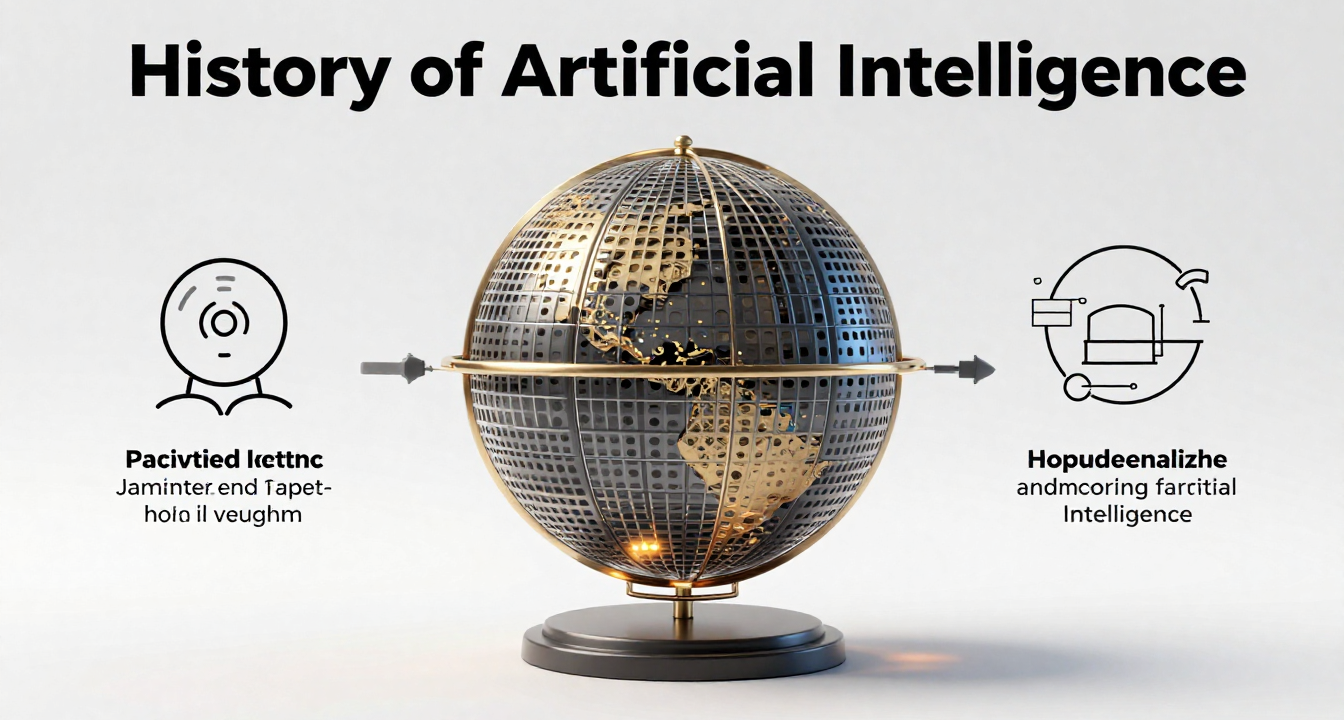
The history of artificial intelligence is filled with visionary thinkers and groundbreaking moments that transformed how we understand machine learning and computational thinking. Understanding the key figures and their contributions helps you appreciate how AI evolved from theoretical concepts into the powerful technology you interact with today.
When you explore the origins of AI, you discover that the field didn’t emerge overnight. Instead, it developed through decades of research, failures, and revolutionary insights from brilliant minds who believed machines could think. These pioneers laid the groundwork for everything from voice assistants to recommendation systems that you use daily.
The Foundations Built by Early Visionaries
Alan Turing stands as one of the most influential figures in artificial intelligence history. His groundbreaking 1950 paper “Computing Machinery and Intelligence” asked a question that still resonates today: “Can machines think?” Turing didn’t just theorize about this problem. He proposed the famous Turing Test, a practical measure of machine intelligence that you might find referenced in discussions about AI capabilities even now. This test suggested that if you couldn’t distinguish between responses from a human and a machine, then the machine could be considered intelligent.
John McCarthy revolutionized the field when he organized the Dartmouth Summer Research Project on Artificial Intelligence in 1956. This conference brought together the brightest minds in computer science and mathematics. The event wasn’t just a meeting. It officially established artificial intelligence as an academic discipline. McCarthy also coined the term “artificial intelligence” itself, giving the field its name and identity. His work on LISP programming language provided tools that researchers used for decades.
Marvin Minsky emerged as another towering figure during these early years. He co-founded the MIT Artificial Intelligence Laboratory and worked extensively on neural networks. Minsky’s contributions to understanding how machines could learn shaped the trajectory of the entire field. His research proved that you could create machines capable of solving complex problems through artificial networks inspired by biological brains.
Revolutionary Breakthroughs in Computing Intelligence
Herbert Simon and Allen Newell created the Logic Theorist in 1956, often considered the first artificial intelligence program. This software could prove mathematical theorems, demonstrating that machines could perform tasks requiring logical reasoning. Their work suggested that problem-solving wasn’t unique to human minds but could be replicated through systematic approaches.
Expert systems represented another major breakthrough that transformed how you interact with technology. Edward Feigenbaum and Joshua Lederberg developed MYCIN, a system that could diagnose blood infections with remarkable accuracy. This showed you how AI could apply human expertise to solve real-world medical problems. During the 1970s and 1980s, expert systems became commercially viable, proving that AI had practical applications beyond academic research.
| Pioneer | Contribution | Year |
|---|---|---|
| Alan Turing | Turing Test and computational theory foundations | 1950 |
| John McCarthy | Coined “AI” and created LISP programming language | 1956 |
| Marvin Minsky | Neural networks research and MIT AI Lab | 1956 |
| Herbert Simon & Allen Newell | Created Logic Theorist program | 1956 |
| Edward Feigenbaum | Developed MYCIN expert system | 1976 |
Modern Era Innovations and Deep Learning
Geoffrey Hinton made transformative contributions to neural networks that you experience in modern AI applications. His work on backpropagation in the 1980s solved a critical problem that had frustrated researchers for years. This technique allowed computers to learn from mistakes, adjusting their internal parameters to improve performance. Without Hinton’s innovations, the deep learning revolution that powers today’s AI systems wouldn’t have been possible.
Yann LeCun advanced computer vision through convolutional neural networks. His research enabled machines to recognize patterns in images, technology that now protects you through security systems and powers facial recognition. LeCun’s work demonstrated that you could train machines to see and interpret visual information with impressive accuracy.
Yoshua Bengio contributed significantly to understanding how deep neural networks could learn complex representations. His research on recurrent neural networks helped machines understand sequential information, which became essential for language processing and translation services you rely on today.
Transformative Moments in AI Development
When IBM’s Deep Blue defeated chess champion Garry Kasparov in 1997, it marked a watershed moment. This victory proved that machines could master strategic thinking at levels exceeding human capability. The event captured public imagination and showed that AI wasn’t just theoretical—it could accomplish remarkable feats.
IBM Watson’s triumph on Jeopardy! in 2011 represented another significant milestone. Unlike chess, Jeopardy! requires understanding wordplay, cultural references, and complex language nuances. Watson’s victory demonstrated that machines could process and interpret human language in sophisticated ways, paving the way for the voice assistants and chatbots you interact with today.
The development of transformers by researchers at Google revolutionized natural language processing. This architecture, introduced in 2017, became the foundation for powerful language models. Understanding transformers helps you recognize why modern AI systems like ChatGPT and other large language models can generate remarkably coherent and contextual responses.
You can explore more about these developments through resources like History.com’s comprehensive overview of artificial intelligence development and Britannica’s detailed article on AI technology. For deeper technical understanding, the Deep Learning textbook provides extensive coverage of modern AI techniques.
The pioneers and breakthroughs that shaped artificial intelligence demonstrate how innovation builds through persistence and collaborative effort. From Turing’s theoretical foundations to today’s transformer-based models,
The Rise of Machine Learning and Deep Neural Networks
The history of artificial intelligence spans decades of innovation, experimentation, and breakthrough discoveries that have transformed how machines learn and think. When you explore the evolution of AI, you uncover a fascinating journey that leads directly to today’s most powerful technologies. Understanding this progression helps you appreciate how machine learning and deep neural networks became central to modern AI.
The foundations of artificial intelligence were laid in the 1950s when computer scientists first imagined machines that could mimic human thinking. Researchers gathered at Dartmouth College in 1956 for a summer workshop that many consider the birth of AI as a formal field of study. During this pivotal meeting, pioneers discussed the possibility that machines could be programmed to simulate human intelligence. These early visionaries believed that with enough computing power and the right algorithms, computers could eventually think like humans.
Throughout the 1960s and 1970s, researchers made tremendous progress developing symbolic AI systems and logic-based approaches. These early machine learning efforts focused on creating rules and representations that allowed computers to solve problems. However, the computing power available at the time was severely limited, which meant progress slowed considerably. The field experienced what many call “AI winters”—periods where enthusiasm dropped and funding dried up because results didn’t match the ambitious promises made earlier.
The Evolution of Machine Learning Approaches
Machine learning represents a fundamental shift in how we approach AI problems. Instead of programming explicit rules into computers, machine learning allows systems to learn patterns directly from data. This approach emerged more prominently in the 1980s and 1990s as researchers developed statistical methods that let algorithms improve their performance through experience.
Decision trees, neural networks, and support vector machines became popular tools during this period. You might not realize it, but these early machine learning techniques laid the groundwork for everything that came afterward. Scientists experimented with training systems on examples, allowing the algorithms to discover relationships and patterns that humans might never think to program explicitly.
The real breakthrough came when researchers realized that computers were finally becoming powerful enough to train increasingly complex models. Personal computers grew faster, storage became cheaper, and the internet made vast amounts of data available. These three factors converged to create the perfect conditions for machine learning to flourish.
Understanding Deep Neural Networks and Their Impact
Deep neural networks represent one of the most significant developments in AI history. These systems are inspired by the structure of biological brains, containing layers of interconnected nodes that process information in sophisticated ways. You can think of them as mathematical models that mimic how neurons communicate with each other.
During the 1980s and early 1990s, neural networks suffered from limited practical success. Training these systems took enormous amounts of time and computing resources. Many researchers abandoned this approach, believing it was a dead end. However, in the mid-2010s, a perfect storm of factors reignited interest in deep learning.
Better algorithms, more powerful graphics processing units (GPUs), and the availability of enormous datasets changed everything. Suddenly, researchers could train deep neural networks to superhuman levels of performance on tasks like image recognition and natural language processing. In 2012, a deep learning team won a major computer vision competition by a massive margin, announcing to the world that deep neural networks were finally delivering on their promises.
Key Milestones in Modern AI Development
| Year | Milestone | Significance |
|---|---|---|
| 1956 | Dartmouth Conference | Official birth of AI as a field of study |
| 1974-1980 | First AI Winter | Funding cuts due to unmet expectations |
| 1980-1987 | Expert Systems Boom | Rule-based systems gained commercial success |
| 1997 | Deep Blue Defeats Kasparov | AI beat world chess champion, shocking the world |
| 2011 | IBM’s Watson Wins Jeopardy! | Natural language processing reached new heights |
| 2012 | Deep Learning Revolution Begins | Neural networks achieve superhuman performance on image recognition |
The journey from symbolic AI to modern deep learning shows how the field constantly adapts and evolves. Each generation of researchers built upon previous work, learning from failures and successes. When researchers encountered problems with one approach, they pivoted toward new techniques and methodologies.
How Data and Computing Power Transformed AI
You might wonder why AI suddenly became so powerful after decades of limited progress. The answer lies in three converging trends. First, the internet generated unprecedented amounts of data that machines could learn from. Second, the cost of computing power dropped dramatically while processing speed increased exponentially. Third, open-source frameworks made it easier for researchers worldwide to collaborate and share improvements.
Companies like TensorFlow and PyTorch democratized deep learning by providing free tools that anyone could use. These frameworks abstracted away much of the complexity, letting researchers focus on solving real problems rather than rebuilding mathematical foundations from scratch.
Big technology companies recognized the potential of machine learning and invested billions into AI research. They needed to process massive amounts of user data, and deep neural networks proved to be the perfect tool for discovering hidden patterns. This commercial interest accelerated progress tremendously.
Real-World Applications Emerge
Today, machine learning and deep neural networks power systems you interact with daily. When you unlock your phone with facial recognition, that’s deep neural networks at work. When you ask a voice assistant a question, machine learning models process your speech. When an algorithm recommends what you should watch next, that’s sophisticated deep learning systems analyzing your preferences.
These applications didn’t emerge overnight. Researchers spent years perfecting techniques, training on massive datasets, and refining approaches. The history of artificial intelligence shows that breakthrough technologies require patience, persistence, and the willingness to learn from countless failures.
How Artificial Intelligence Transformed Business and Society
Artificial intelligence has revolutionized the way we work, think, and interact with technology. What started as a theoretical concept in academic settings has become a driving force reshaping every corner of business and society. Understanding how AI transformed these areas helps us appreciate the changes happening around us today and prepares us for what comes next.
The Early Days of Machine Learning and Automation
The journey of artificial intelligence reshaping business began decades ago when computers first learned to perform tasks without explicit programming. Companies realized they could automate repetitive work, freeing up employees to focus on more creative and strategic responsibilities. This shift didn’t happen overnight—it required patience, investment, and a willingness to trust machines with important processes.
Manufacturing plants were among the first to embrace this technology. Robots powered by AI algorithms could assemble products with precision, speed, and consistency that humans simply couldn’t match. Factories reduced errors, increased output, and cut costs dramatically. Workers transitioned from performing mundane assembly tasks to managing and maintaining these intelligent systems, creating new job categories that demanded different skills.
The financial sector also recognized the potential early on. Banks and investment firms used AI to detect fraudulent transactions, manage risk, and predict market movements. These applications didn’t replace human expertise—they enhanced it. Analysts and traders could now focus on strategic decisions while machines handled the data processing that would have taken them hours.
How AI Changed Customer Experience and Business Operations
One of the most visible transformations happened in customer service. Chatbots and virtual assistants powered by artificial intelligence now handle thousands of customer inquiries simultaneously. You’ve probably interacted with these systems when seeking help from a company. They answer questions instantly, available 24/7, without requiring human staff to work overnight shifts.
Businesses discovered that AI could analyze customer behavior patterns in ways that humans never could. By examining purchase history, browsing habits, and preferences, companies personalize your shopping experience. When you visit an online store, the recommendations you see aren’t random—they’re generated by sophisticated algorithms designed to suggest products you’re most likely to buy.
Supply chain management transformed dramatically thanks to artificial intelligence. Companies use AI to predict demand, optimize inventory levels, and plan shipping routes efficiently. This means products reach stores faster, waste decreases, and prices become more competitive. During unexpected disruptions like natural disasters or pandemics, AI helps businesses quickly adjust their operations and find alternative solutions.
Artificial Intelligence’s Impact on Healthcare and Medical Innovation
Healthcare represents one of the most significant areas where AI has made a real difference in people’s lives. Doctors now use AI diagnostic tools to detect diseases like cancer, heart conditions, and diabetes earlier than traditional methods allowed. Machine learning algorithms analyze medical images with incredible accuracy, sometimes spotting problems that human eyes might miss.
Drug development, which typically took years and cost billions of dollars, now moves faster with AI assistance. These systems can analyze millions of molecular combinations to identify promising candidates for new medications. Researchers spend less time on dead-ends and more time pursuing treatments with genuine potential. For patients waiting for cures, this acceleration in research timelines means hope arrives sooner.
Personalized medicine has become possible through artificial intelligence. Your genetic profile, medical history, and lifestyle factors can be analyzed to recommend treatments tailored specifically to you. Rather than a one-size-fits-all approach, doctors increasingly prescribe medications and therapies designed for your unique biology.
Workplace Changes and Employment Transformation
The introduction of artificial intelligence into workplaces sparked both excitement and concern among workers. Some jobs disappeared as machines took over routine tasks, but new positions emerged that didn’t exist before. Companies needed people to train AI systems, manage them, and interpret their outputs. Data scientists, machine learning engineers, and AI ethics specialists became in-demand roles.
Productivity increased substantially as employees used AI tools to accomplish more in less time. A marketing team might use AI to analyze campaign performance across dozens of channels simultaneously. An accountant might use automation to process invoices in seconds rather than hours. This efficiency boost meant companies could do more with their existing workforce or invest savings into growth.
Remote work became more feasible partly because of AI technology. Virtual meeting platforms use artificial intelligence to transcribe conversations, schedule optimal times, and even help manage calendars. Teams spread across different cities and time zones could collaborate as effectively as those sitting in the same office.
Social Impact and Everyday Life
Beyond business, artificial intelligence has transformed how society functions. Navigation apps use AI to predict traffic patterns and suggest faster routes. Social media platforms employ algorithms that decide what content appears on your feed. Streaming services recommend movies and shows based on your watching habits. These technologies have become so integrated into daily life that you probably don’t think about them as AI anymore—they’re just part of how things work.
Education has shifted as well. Students now access personalized learning platforms that adapt to their pace and style. An AI tutoring system can identify exactly where a student struggles and provide targeted help, while another student moves ahead quickly without waiting. Teachers gain insights into each student’s progress and learning patterns, allowing them to provide better support.
Smart homes demonstrate AI’s presence in personal spaces. Your thermostat learns your temperature preferences and adjusts automatically. Security systems recognize familiar faces and alert you to strangers. Refrigerators can suggest recipes based on ingredients inside. What seems like convenience actually relies on sophisticated artificial intelligence working quietly in the background.
Challenges and Ethical Considerations
As artificial intelligence expanded its reach, important questions emerged about fairness, privacy, and accountability. AI systems trained on biased data can perpetuate discrimination in hiring, lending, and criminal justice. A resume-screening AI might unfairly favor certain demographic groups if its training data reflected past discrimination. Society had to grapple with how to build AI systems that treat everyone fairly.
Privacy concerns grew as companies collected more personal data to power their AI systems. Your browsing history, location, contacts, and preferences create a detailed picture of who you are. Protecting this information became crucial, leading to regulations like GDPR in Europe and various data protection laws worldwide.
The environmental impact of training massive AI models also deserves attention. These systems require enormous computing power, consuming significant electricity and generating carbon emissions. Companies and researchers increasingly focus on developing more efficient AI that achieves results with less environmental cost.






No Comments